
No products in the basket.

New regulations came into force on 1 October 2026, introducing additional financial and administrative responsibilities for developers undertaking certain residential building projects in England.
The Building Safety Levy (England) Regulations 2025 introduce a levy on qualifying residential developments, helping to fund the remediation of building safety defects, particularly those associated with unsafe cladding and historic building safety issues.
Although introduced through legislation made in 2025, the levy became operational on 1 October 2026. The regulations have also been amended by the Building Safety Levy (Amendment) (England) Regulations 2026.
For developers and construction businesses, understanding whether a project is liable, how charges are calculated and when payment is required is essential to effective project planning and avoiding delays at completion.
The Building Safety Levy is a government charge applied to certain new residential developments in England.
Its primary purpose is to raise funding towards the cost of addressing historic building safety defects, reducing the financial burden on affected leaseholders and taxpayers.
The levy forms part of the wider building safety reforms introduced following the Grenfell Tower tragedy and the subsequent implementation of the Building Safety Act 2022.
Unlike planning application fees or normal building control charges, the levy is calculated principally using the amount of chargeable residential floorspace within a development.
Importantly, the levy is not limited to Higher-Risk Buildings (HRBs). Residential developments below the 18-metre or seven-storey HRB thresholds may also be liable where the relevant charging conditions are met.
The levy generally applies to qualifying building control applications submitted on or after 1 October 2026 where the proposed works form part of a major residential development and create new chargeable residential floorspace.
A major residential development generally means:
Developments potentially affected include new-build housing estates, apartment blocks, qualifying student accommodation and conversions of non-residential buildings into residential accommodation.
Extensions or alterations that create additional residential floorspace may also be chargeable where the wider development meets the required conditions.
A key consideration is that the threshold is assessed against the wider development and relevant planning permission, not simply an individual building control application.
For example, a developer constructing 30 houses across three phases of 10 properties cannot necessarily avoid the levy by submitting separate building control applications for each phase.
Similarly, an individual application for five properties could still be chargeable if those properties form part of a larger residential development of 20 homes.
The regulations also apply to qualifying conversions, including the conversion of commercial offices into residential flats.
Not every residential development will be required to pay the levy.
The regulations provide exemptions based on development size, building use, the nature of the accommodation and, in some cases, the organisation carrying out the development.
| Building or development type | Levy position |
| Residential developments of fewer than 10 new dwellings | Exempt where not part of a larger qualifying development |
| PBSA developments of fewer than 30 new bedspaces | Exempt where not part of a larger qualifying development |
| Qualifying social housing | Exempt floorspace |
| Qualifying supported housing | Exempt floorspace |
| Developments undertaken by non-profit registered social housing providers or wholly owned subsidiaries | Exempt |
| Care homes and qualifying hospitals | Exempt |
| Hotels, hostels and almshouses | Exempt |
| School residential accommodation | Exempt |
| Children’s homes and qualifying children’s supported accommodation | Exempt |
| Domestic abuse refuges and qualifying temporary accommodation for homeless people | Exempt |
| Prisons and qualifying secure residential institutions | Exempt |
| Monasteries, nunneries, seminaries and similar establishments | Exempt |
Additional exclusions and detailed definitions apply under Schedules 1 and 2 of the regulations.
A development containing both exempt and non-exempt accommodation may still be required to pay the levy on the chargeable element, including an appropriate proportion of shared communal floorspace.
Projects with building control applications submitted before 1 October 2026 are generally outside the levy, subject to the transitional provisions.
Developers should not automatically assume that an exemption applies because a project provides affordable housing or specialist accommodation. The relevant statutory definitions, developer status and development arrangements must be checked.
The amount payable depends on three principal factors:
Each local authority in England has its own published levy rate. Developments qualifying as previously developed sites receive a rate approximately 50% lower than the standard rate.
To qualify for the discounted rate, generally at least 75% of the land within the relevant planning permission boundary must meet the levy regulations’ definition of previously developed land.
The following are examples of published rates.
| Local authority | Previously developed land (per m²) | Other land (per m²) |
| Mansfield | £9.12 | £18.23 |
| Nottingham | £11.77 | £23.55 |
| Birmingham | £14.62 | £29.23 |
| Manchester | £14.22 | £28.44 |
| Newcastle upon Tyne | £9.85 | £19.71 |
| Leeds | £12.29 | £24.57 |
| Bristol | £21.48 | £42.97 |
The full nationwide schedule is available in GOV.UK Building Safety Levy Rates and Calculations. Example: How much could a development cost?
Consider a qualifying residential development in Mansfield containing 2,000 m² of chargeable residential floorspace.
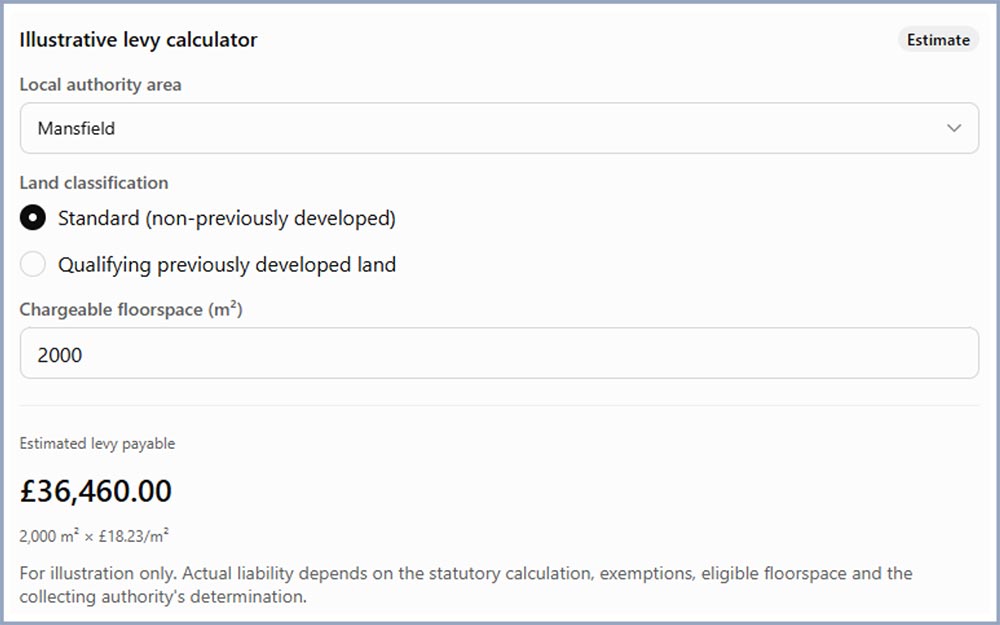
These charges could represent a significant additional financial consideration for residential developers, particularly where larger developments are undertaken over multiple phases.
It is therefore important that developers include potential levy costs in feasibility assessments, project budgets and financial forecasts at an early stage.
The legal responsibility for paying the levy rests with the named client associated with the relevant building control application.
In most cases, this will be the property developer or organisation commissioning the development, although the precise position depends on the application’s named-client arrangements.
Principal contractors, designers and building control professionals may assist with the necessary information and documentation, but this does not automatically make them legally responsible for payment.
The levy is administered and collected by the relevant local authority acting as the collecting authority.
Developers must provide levy-related information through the appropriate building control process, even where residential works are not chargeable and information is required to demonstrate an exemption.
The procedure will depend on whether building control approval is being obtained through the local authority, a Registered Building Control Approver (RBCA), or the Building Safety Regulator (BSR).
Provide the initial levy information with the relevant building control approval application or initial notice, including the number of proposed new dwellings or student bedspaces and relevant planning permission details.
Submit the required levy information with the applicable commencement notice. For chargeable works, this includes supporting information such as chargeable floorspace and evidence relevant to exemptions or discounted land rates.
The collecting local authority will calculate the liability and issue a levy liability notice or a notice confirming that no charge is due. The normal determination period is five weeks, or eight weeks where a spot-check applies, subject to permitted extensions.
Pay the amount due using the method specified by the local authority. The levy must be settled before the relevant completion, or final certification process can be concluded.
Once full payment has been received, the collecting authority must issue a levy payment certificate within two weeks. This should be retained with the project’s building control and compliance records.
Where the development changes during construction, updated levy information may also be required, particularly where alterations affect the number of dwellings, exempt accommodation or chargeable floorspace.
Failure to provide the appropriate information may result in a building control application or notice being rejected, while non-payment can prevent the issue or acceptance of the relevant completion or final certificate.
For project-specific levy enquiries, developers should contact the local authority responsible for collecting the levy in the area where the development is situated.
The local authority should be the first point of contact for matters such as levy calculations, documentary evidence, exemption eligibility, liability notices, payment arrangements and requests for review.
Where a Registered Building Control Approver is being used, developers should also consult their appointed approver about the information required with the building control application and subsequent notices.
For developments classified as Higher-Risk Buildings, the Building Safety Regulator is responsible for the relevant building control functions, although the local authority remains responsible for collecting the levy.
Developers can also access national guidance through the Ministry of Housing, Communities and Local Government.
Official information:
Where a developer believes a charge has been calculated incorrectly or an exemption has not been properly recognised, a formal review may be requested.
Under Regulation 71, the request must normally be submitted in writing to the collecting authority within 28 days of the relevant liability notice or refund decision.
The collecting authority must review the decision, with further rights of appeal to the First-tier Tribunal where the statutory conditions are met.
Developers should retain appropriate records and supporting evidence where a charge is disputed.
At Workforce Skills Support Ltd, we understand the challenges that contractors, developers and construction professionals face when navigating changes to building safety legislation.
The introduction of the Building Safety Levy reinforces the importance of early project planning, clear allocation of responsibilities, accurate documentation and effective communication between those involved in construction projects.
Although the levy is primarily a financial and administrative obligation for developers, it forms part of the wider building safety regulatory framework.
Workforce Skills Support provides construction training and professional development designed to help organisations improve their understanding of legal duties, develop workforce competence and strengthen their construction health and safety management arrangements.
Understanding the Building Safety Act training
Our Building Safety Act training can help developers, principal contractors, designers and construction managers understand their responsibilities under the wider building safety regime.
Training can cover:
If you’d like to find out more about the Building Safety Levy 2026, contact Workforce Skills Support today.